How to use the amount to words converter
- Enter the amount in figures. Commas, spaces and a currency symbol are ignored, so
₹1,25,000.50,125000.5and1 25 000.50all work. - Pick the currency. Rupees use the Indian system (lakh, crore) and the other currencies use the international system (million, billion). You can override this with Number system.
- Choose the style. Title Case or CAPITALS suit cheques, hyphens give “Twenty-Five”, and the British option adds “and” after hundreds. Untick Only if you do not want it at the end.
- Copy the line you need. The cheque card shows the main wording; the rows underneath give the Indian and international versions, the grouped figures and, for dollars, a US check line.
Why write an amount in words?
Figures are easy to alter: a 1 can become a 7 and an extra zero turns 5,000 into 50,000. Words are much harder to change without leaving a trace, which is why banks, accountants and lawyers ask for the amount in both forms.
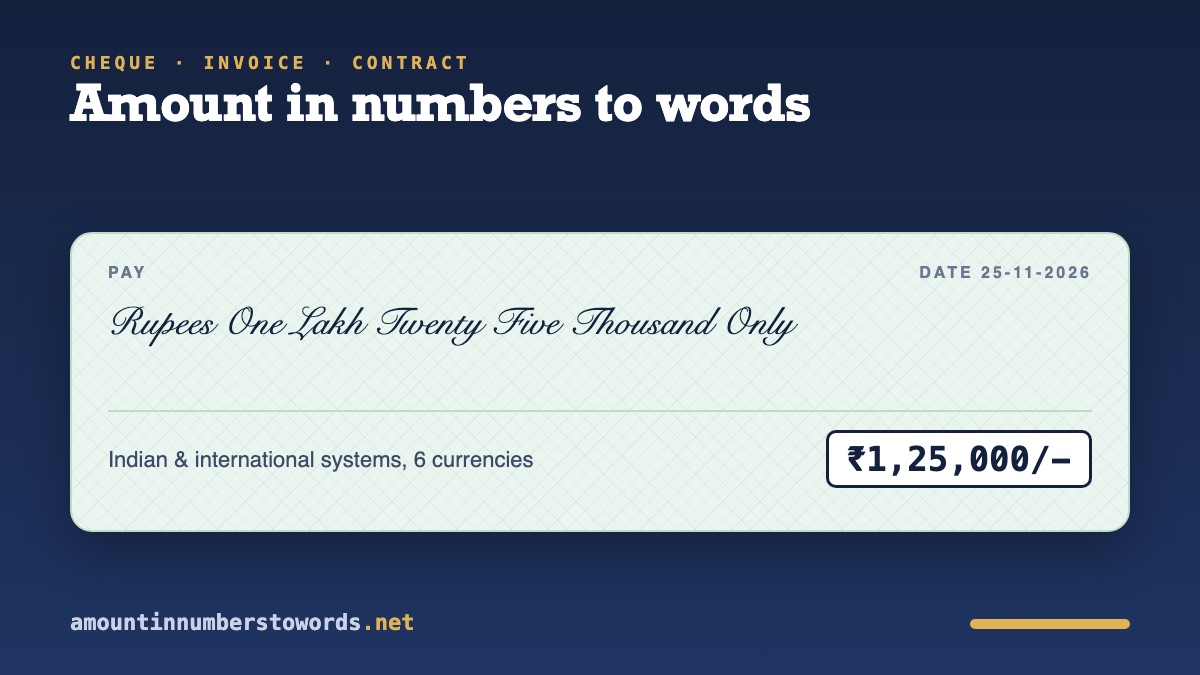
- Cheques in India, the USA, the UK, the Gulf and elsewhere have a line for words and a box for figures. See the cheque writing guide.
- Invoices and receipts — many businesses print the grand total in words under the figures, for example “Rupees Twelve Thousand Five Hundred Only”.
- Contracts, loan papers and rent agreements state the key sums in words and figures, usually as “Rupees Fifty Thousand (₹50,000)”.
- Demand drafts, bank forms and challans also ask for the amount in words.
One amount, every format
Here is how the converter writes ₹12,50,000.75:
| Format | Result |
|---|---|
| Cheque wording (INR) | Rupees Twelve Lakh Fifty Thousand and Seventy Five Paise Only |
| Indian system | Twelve Lakh Fifty Thousand |
| International system | One Million Two Hundred Fifty Thousand |
| Figures | 12,50,000.75 (Indian) · 1,250,000.75 (international) |
Notice that the digits are identical — only the grouping and the names change. The lakh, crore, million and billion chart explains the two systems side by side.
Amounts in words by currency
Popular amounts written in words
Quick answers for the amounts people look up most often. Each page shows the cheque wording, both number systems and a place-value breakdown.
Spelling rules the converter follows
- Numbers from 21 to 99 are written as two words (“Twenty Five”) or, if you tick Hyphens, with a hyphen (“Twenty-Five”), which is the standard in American and British style guides.
- “And” is used before the cents, paise or pence. With the British option it is also used after hundreds: “One Hundred and Five”.
- Indian amounts of 100 crore or more repeat the scale word, as in “One Lakh Crore”, which is how Indian banks and newspapers write them.
- Decimals are rounded to two places because no common currency has a smaller unit in everyday use.
The number spelling rules guide covers these conventions in more detail.
Frequently asked questions
How do I write an amount in words?
Write the whole-number part in words, add the currency name, then the decimal part with the sub-unit — for example “Rupees Two Thousand Five Hundred and Fifty Paise Only” for ₹2,500.50. The converter above does this automatically.
Should I write “Only” at the end?
On cheques and invoices, yes. “Only” marks the end of the amount so nothing can be added after it. It is ticked by default; untick it for contracts or letters where it is not needed.
What is the difference between the Indian and international number systems?
The Indian system groups digits as 12,34,56,789 and uses thousand, lakh and crore. The international system groups them as 123,456,789 and uses thousand, million and billion. 10 lakh equals 1 million and 1 crore equals 10 million.
How large an amount can I convert?
Up to 15 digits — 999 trillion, or 9,99,99,99,99,99,999 in the Indian system — with up to two decimal places.
Is my amount sent anywhere?
No. The conversion runs in your browser and nothing you type is uploaded or stored.